You Googled "Average Wedding Cost" and the Number Made You Sick. Now What?
$33,000 in the US. $30,000 in the UK. $35,000 in Australia. You saw the number, did the mental math against your savings account, and felt your stomach drop. Welcome to the gap between what the wedding industry says is "normal" and what your bank account says is real.
So you did what every overwhelmed, freshly engaged person does: you opened The Knot's budget tool, or downloaded a Google Sheets template, or bought a $7 spreadsheet on Etsy. And within an hour, you discovered the problem. These tools tell you that you're over budget. They turn cells red. They show a pie chart in an alarming shade of orange. But not one of them tells you how to fix it — how to negotiate a vendor quote down, what the "service charge" on your venue invoice actually means, or that you need to budget separately for postage, vendor meals, alterations, overtime fees, and a dozen other costs that never appeared on any free checklist.
The wedding industry has an incentive problem. The platforms where you're doing your planning — The Knot, Zola, WeddingWire — make their money from vendor advertising. Their budget tools push you toward "market averages" that are inflated by their own paying clients. They don't tell you how to spend less. And generic spreadsheets? They're blank grids. They calculate but they don't educate. If you don't already know what line items belong in the "Venue" category beyond the rental fee, the spreadsheet isn't going to warn you.
The Wedding Budget Planner is the financial strategy system for your wedding. It's not a calculator. It's not a pretty spreadsheet with watercolor borders. It's the complete budget playbook — an 87-page guide plus 8 standalone printable tools: hidden cost checklist, vendor negotiation scripts, country-specific tipping and tax guide, budget tracker, cost-per-guest calculator, payment schedule, substitution checklists, and family money scripts. It treats your wedding like the five-figure financial project it actually is.
What's Inside the Complete Planner
Category-by-Category Budget Tracker
Track spending across 12+ wedding categories — venue, catering, photography, attire, flowers, music, stationery, beauty, transportation, favours, officiant, and miscellaneous — with sub-line items that catch costs generic tools miss. Every category includes the hidden charges that actually appear on final invoices: service charges, overtime, corkage fees, cake-cutting fees, vendor meals, alteration costs, postage, and more.
Hidden Cost Checklist (47+ Line Items)
The comprehensive list of wedding costs that never appear on free budget tools: postage for three rounds of mail (invites, RSVPs, thank-yous), dress alterations and steaming, undergarments, vendor meals at the reception, marriage licence fees, venue insurance, A/V equipment rentals, parking and travel surcharges, and tips for vendors in countries where tipping is expected. Missing even three of these can put you $1,000-$2,000 over your planned total without any conscious overspending.
Vendor Negotiation Scripts
Copy-and-paste email scripts for the conversations most couples are too uncomfortable to have. These aren't "can I have a discount?" requests — they're strategically framed customisation asks that let vendors lower your quote without feeling devalued. Scripts for off-peak date pivots, package customisation, bundling multiple services, early payment incentives, and the specific language for asking about pricing flexibility without undermining the vendor relationship. One script used once can save more than the cost of this entire planner.
Cost-Per-Guest Calculator
The guest list is the single biggest lever on your total budget. This calculator shows you exactly what each additional guest costs across catering, drinks, favours, stationery, and seating — so when your parents suggest adding 15 people you haven't spoken to in a decade, you have a concrete dollar figure to anchor the conversation.
Tax and Tipping Guide for US, UK, Canada, Australia, and NZ
Tipping norms, tax rules, and hidden surcharges differ dramatically between countries — and most wedding advice is written exclusively for the American market. In the US, "service charges" don't go to staff and you're expected to tip on top. In the UK, VAT (20%) is often quoted separately on venue contracts. In Australia, vendors who quote "plus GST" to consumers are breaking the law. In New Zealand, tipping is uncommon and can feel culturally inappropriate. This guide covers each country specifically so you budget for what's actually expected in your region, not in someone else's.
Vendor Payment Schedule
A running record of every deposit paid, every balance due, every upcoming payment deadline across all your vendors. Keeps your cash flow visible so you're never blindsided by a payment you forgot was coming — and never risk voiding a contract because you missed a due date buried in paragraph 14 of the vendor agreement.
Money-Saving Substitution Checklists
Tactical swaps that reduce cost without reducing quality: repurposing ceremony flowers for the reception, choosing a brunch reception over an evening dinner, selecting seasonal flowers over imported ones, and a dozen other category-specific substitutions with estimated savings. These aren't generic "skip the favours" tips — they're vendor-informed swaps that maintain the experience while cutting the spend.
Family Money Conversation Scripts
Specific language for the two hardest financial conversations in wedding planning: asking parents whether they intend to contribute (without making it awkward), and setting boundaries if that contribution comes with strings attached — like control over the guest list, venue choice, or traditions. These scripts reframe the conversation from "we need money" to "we're planning our budget and want to include you in a way that works for everyone."
Who This Is For
This planner is for engaged couples who:
- Have experienced the "sticker shock" moment of looking up average wedding costs and realising their budget doesn't match the industry average — and need a system to make their real budget work
- Are managing the wedding budget themselves, without a financial planner or a full-service wedding coordinator handling the money side
- Have already tried free budget tools (The Knot, Zola, Google Sheets) and found them too generic, too rigid, or too focused on spending rather than saving
- Are planning on a tight budget — whether that's $5,000 or $50,000 — and understand that smaller budgets are actually harder to manage because every dollar counts and every hidden cost hurts more
- Are getting married in the US, UK, Canada, Australia, or New Zealand and want tax, tipping, and pricing guidance that reflects their actual country, not just American norms
- Are navigating family financial contributions and need a framework for the "strings attached" conversation before accepting money
After Using This Planner, You'll Be Able To
- Track your actual wedding spend across every category and sub-category — with no surprises in the final week because you missed costs that free tools never listed
- Send a vendor a professionally worded email that negotiates a lower quote without damaging the relationship — using the specific customisation-not-discount framing that experienced planners use
- Identify the hidden costs on a venue invoice — including the difference between a "service charge" and a "gratuity," which alone can be a $500-$1,500 discrepancy
- Know exactly what your cost-per-guest is, so you can have a data-backed conversation when the guest list starts creeping up
- Budget accurately for tips, taxes, and surcharges in your specific country — not based on American advice that doesn't apply to UK VAT, Australian GST, or New Zealand tipping norms
- Schedule every vendor payment in one place so nothing slips through and your cash flow stays predictable across 8-18 months of planning
- Have the family money conversation with scripts that set boundaries without creating conflict
Why Not Just Use a Free Tool?
Free budget tools and cheap spreadsheets exist everywhere. Here's what they consistently fail to do:
- They track spending. They don't prevent overspending. A budget tool that turns cells red after you've already overspent is not a strategy. The Wedding Budget Planner includes negotiation scripts, substitution checklists, and hidden cost warnings that prevent the overspend from happening in the first place.
- They list 8 categories. Your wedding has 47+ line items. "Photography" is a single row in a free spreadsheet. In reality, it includes the session fee, second shooter, travel, prints, albums, USB delivery, engagement shoot add-on, and overtime. The Planner breaks each category into the actual sub-costs that appear on final invoices.
- They're built to sell you vendors, not save you money. The Knot and Zola are vendor marketplaces. Their budget tools exist to drive bookings through their platforms, not to help you spend less. The Wedding Budget Planner has no vendor affiliations, no paid listings, and no incentive to inflate your spending.
- They assume you're American. If you're planning a wedding in the UK, Australia, Canada, or New Zealand, the tipping advice is wrong, the tax treatment is wrong, and the hidden fee warnings are incomplete. This planner covers each country's specific norms and legal protections.
Free tools give you a calculator. This planner gives you a financial strategy.
— Less Than the Cost of Feeding One Guest
The average per-head catering cost at a wedding is $70-$150 depending on your region. If the hidden cost checklist catches one fee you didn't know about, or one negotiation script saves you $300 on a single vendor, the planner has paid for itself before you've finished the first section.
A cheap Etsy spreadsheet gives you a calculator. A generic book gives you theory. A $2,000 wedding planner gives you a service. This planner gives you the strategy layer in between — the education, the scripts, the regional specifics, and the tracking system that makes your budget work in the real world where vendors send invoices with line items you've never heard of.
30-day money-back guarantee. If you don't find it useful, email us and we'll refund you, no questions asked.
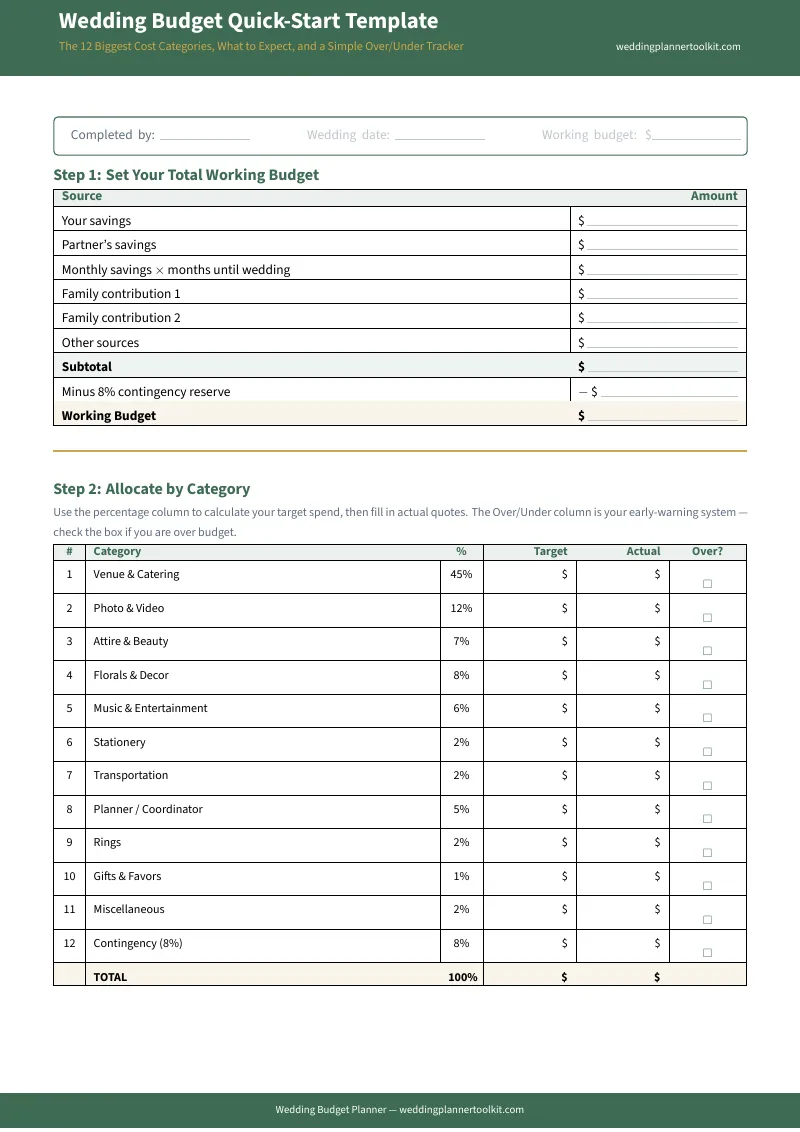
Not ready for the full planner? Download our free Wedding Budget Quick-Start Template — a one-page budget overview with the 12 biggest wedding cost categories, average percentage breakdowns, and a simple over/under tracker to get started tonight.
Stop wondering where your budget went. Start controlling where it goes. Get the system that catches hidden costs, negotiates vendor quotes, and keeps your actual spend visible from the first deposit to the last payment.