You Picked a Dream Location. Now You're Realising Nobody Can Tell You How to Actually Get Married There.
You've chosen the place — Tuscany, Tulum, Montego Bay, the Amalfi Coast. The photos in your head are stunning. But somewhere between the excitement and the first Google search, reality hit: getting legally married in another country is not the same as booking a venue and showing up.
The US Embassy page says one thing. The Italian consulate says another. A resort website says "we handle everything" — but a forum post from last year says the same resort lied about a couple's marriage license and the ceremony wasn't legally binding. Your mum is asking questions you can't answer. Your guests are asking who pays for flights. And you're up at 2am reading contradictory advice about blood tests, Apostilles, and whether you need a "Certificate of No Impediment" or an "Atto Notorio" — and you're not even sure what either one is.
This is the reality of destination wedding planning that Instagram never shows. It's not a Pinterest board problem. It's a cross-border bureaucracy problem, a remote vendor management problem, and a guest logistics problem — all happening simultaneously, in a country where you may not speak the language, on a timeline that doesn't forgive mistakes.
The Destination Wedding Guide is the planning system that replaces 3am panic-scrolling with clear, country-specific, step-by-step action plans. It was built for couples who want their wedding abroad to be the adventure they imagined — not a bureaucratic nightmare they barely survived.
What's Inside — 79-Page Guide + 8 Standalone Printable Worksheets
Legal Requirements by Country — Segmented by Your Citizenship
This is the section that no other guide offers. Legal marriage requirements depend on where you're from, not just where you're going. The guide gives you specific, printable checklists for US, UK, Canadian, Australian, and NZ couples — covering the documents you need, the timelines for obtaining them, and the exact offices you'll deal with. Covers popular destinations including Mexico, Italy, Jamaica, Greece, Thailand, Spain, Portugal, and the Caribbean. Includes the "blood test reality check" for Mexico (yes, it varies by state), the Ferragosto warning for August weddings in Italy, and the post-Brexit documentation changes for UK couples in Europe.
Symbolic vs. Legal Wedding Decision Framework
Should you get legally married at home and have a symbolic ceremony abroad? About 80% of destination couples do — but most don't know it's an option until months into planning. This decision matrix walks you through the pros, cons, and logistics of each path: full legal ceremony abroad, symbolic ceremony with home-country legal marriage, or a combination. Saves you from pursuing a complex legal path (like the 40-day residency requirement in France) when a simpler route gives you the same result.
Guest Communication Templates
The hardest conversation in destination wedding planning is money. Who pays for flights? Is the hotel room included? Can guests bring plus-ones? Is it okay to decline? This section gives you copy-and-paste scripts for your wedding website, save-the-date messages, and email updates — polite, clear, boundary-setting language that answers every question your guests are afraid to ask. Covers adults-only policies, travel cost expectations, room block logistics, and how to gracefully handle guests who can't afford to attend.
Remote Vendor Vetting and Communication Guide
Hiring a vendor from 5,000 miles away without local references is one of the highest-risk decisions in destination wedding planning. This section covers how to vet vendors remotely, what red flags look like in foreign contracts, how to handle time zone and language barriers, and what to do when a vendor goes silent. Includes a cultural translator section — explaining why your Italian planner isn't ignoring you (it's August), why your Mexican coordinator quoted a different price than the website, and how response norms differ by country.
Destination Wedding Budget Worksheet
Destination weddings have cost categories that don't exist in local weddings: welcome dinners, airport transfers, room blocks, group excursions, destination-specific vendor pricing, and currency conversion surprises. The worksheet covers all of them — with line items for the costs that catch couples off guard and a running tracker that shows your total commitment as bookings accumulate.
Travel Coordination and Packing Checklist
Managing your own travel is complicated enough. Managing travel logistics for 30-80 guests across multiple time zones — flights, hotel blocks, airport transfers, dietary requirements, mobility considerations — is a project unto itself. The coordination section includes a guest travel tracker, room block management system, welcome bag checklist, and the packing list that covers everything from the dress to the legal documents you cannot forget.
Contingency and Crisis Planning
What if the resort loses power? What if a hurricane warning hits three days before your wedding? What if the vendor ghosts? What if half your guests can't get visas? Destination weddings are uniquely exposed to disruptions that don't affect local weddings. This section provides "What If" scenarios with concrete action plans — not generic advice, but specific steps for the most common (and most devastating) destination wedding failures.
Who This Guide Is For
This guide is for couples who:
- Have chosen a destination — or are seriously considering one — and need to understand the legal, logistical, and financial reality before committing
- Are US, UK, Canadian, Australian, or NZ citizens planning a wedding abroad and need legal requirements specific to their nationality, not generic American-only advice
- Are planning without a full-service destination wedding planner and need a structured system to manage the process themselves
- Are dreading the "who pays for what" conversation with their guests and want polite, pre-written scripts that set boundaries without damaging relationships
- Are considering a symbolic ceremony abroad with a legal marriage at home — and want a clear framework for deciding which path is right
- Are managing international guest travel logistics and need a system that doesn't involve 47 spreadsheet tabs
- Have already hit the wall of contradictory embassy pages, forum advice, and resort marketing — and want one authoritative source that cuts through the noise
After Using This Guide, You'll Be Able To
- Know exactly which legal documents you need, where to get them, and how far in advance — specific to your citizenship and your destination
- Make the symbolic vs. legal ceremony decision with confidence, based on a clear comparison of logistics, cost, and legal implications for each path
- Send your guests clear, polite communication about travel costs, accommodation expectations, and logistics — without the awkward conversations
- Vet remote vendors confidently, spot red flags in foreign contracts, and communicate across time zones and cultural norms
- Build a destination wedding budget that includes the cost categories local wedding guides don't mention — welcome dinners, transfers, room blocks, currency conversion
- Coordinate travel for your entire guest list without losing track of who's confirmed, who needs airport transfers, and who has dietary requirements
- Have a concrete contingency plan for weather, vendor no-shows, guest cancellations, and the other disruptions that are unique to weddings abroad
Why Not Just Piece This Together From Google?
You can try. Here's what you'll find:
- Embassy websites that don't talk to each other. A US couple marrying in Italy needs to check the US State Department, the Italian Embassy in the US, AND the local Comune in Italy. Each gives partial information in different formats, and none of them explain what to do when the requirements conflict.
- Resort websites that push symbolic ceremonies to avoid their own paperwork. Resorts make more money when the legal process is your problem, not theirs. They gloss over the difficulty of legal weddings to close the booking — and many couples don't realise they had a symbolic ceremony until after the honeymoon.
- Forum advice that's anecdotal and sometimes dangerous. "We didn't need a blood test in Mexico!" — possibly because they had a symbolic ceremony without realising it. Every couple's situation depends on their citizenship, their destination, and the specific municipality. What worked for a stranger on Reddit may not apply to you.
- Amazon books published before 2020. The best-selling destination wedding books don't account for post-COVID travel realities, Brexit impacts on UK couples in Europe, or recent changes in marriage laws across popular destinations.
Free resources give you fragments. This guide gives you a complete, current, nationality-specific system.
— Less Than the Cost of One Courier Fee
The average destination wedding costs $25,000 to $40,000. Missing a single document deadline means express courier fees ($200+), rescheduled appointments at foreign government offices, and the sick feeling that your wedding day might not go as planned. One wrong assumption about blood test requirements, Apostille rules, or residency timelines can cost you weeks of delay and hundreds of dollars in corrections.
For a fraction of your wedding budget, you get the legal roadmap, the guest communication scripts, the vendor vetting system, and the contingency plans that would otherwise take dozens of hours of research across government websites, forums, and resort marketing pages that may not have your best interests in mind.
30-day money-back guarantee. If you don't find it useful, email us and we'll refund you, no questions asked.
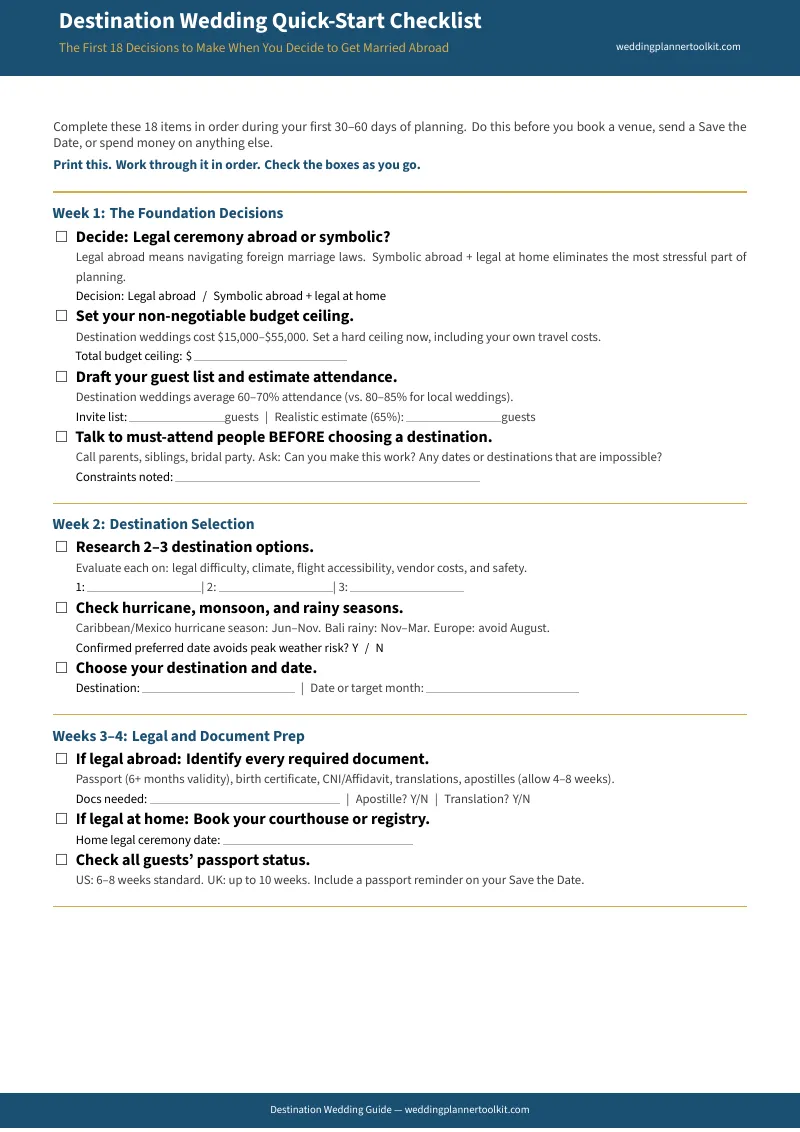
Not ready for the full guide? Download our free Destination Wedding Quick-Start Checklist — the first 10 decisions every couple needs to make when planning a wedding abroad, including the legal vs. symbolic question, guest communication timeline, and venue research steps.
Stop panic-scrolling embassy websites at 3am. Get the guide that tells you exactly what you need, when you need it, and how to get it — for your country, your destination, and your situation.