You've Planned the Wedding. But Who's Actually Running It on the Day?
You've booked the venue. You've hired the photographer, the caterer, the DJ, the florist. You've chosen the dress, finalised the seating chart, and confirmed the menu. You've been planning for months — maybe over a year. By any measure, you're organised.
But here's the thing nobody tells you until it's almost too late: planning a wedding and coordinating a wedding are two completely different jobs.
Planning is choosing the caterer. Coordinating is knowing what to say to the caterer when dinner service is running 20 minutes behind and the speeches haven't started. Planning is booking the photographer for 4pm. Coordinating is making sure the bridal party is in position, the buttonholes are pinned, the confetti is distributed, and the sound system is tested — all before the photographer arrives. Planning is choosing the playlist. Coordinating is telling the DJ to cut the background music for the father-of-the-bride speech without being asked.
Professional day-of coordinators charge $800 to $3,000 for this work. They're worth it. But if your budget doesn't stretch that far — or if you've already allocated those funds elsewhere — you don't have to choose between hiring a professional and hoping for the best.
The Day-of Coordination Kit is the operational system that turns a willing friend, a capable maid of honour, or even you and your partner into a confident day-of coordinator. It's not a pretty timeline template. It's the actual playbook — the scripts, the cue sheets, the emergency protocols, and the delegation framework that professionals use to keep weddings running on time and on plan.
What's Inside the Complete Kit
Hour-by-Hour Timeline Builder
Not a blank schedule you fill in with guesswork. A structured timeline builder with realistic duration guidance for every phase of the day — getting ready, first look, ceremony, cocktail hour, dinner, speeches, dancing, send-off. Includes separate timeline modules for US format (first look before ceremony) and UK/Australian format (ceremony first, speeches after dinner, longer reception). You'll know exactly how much time each block actually takes, not how much time you wish it took.
Vendor Contact Sheet & Day-of Logistics Matrix
A single printable page with every vendor's name, phone number, arrival time, setup requirements, and key contact person — so whoever is coordinating your day doesn't have to dig through emails and contracts to find a phone number at 2pm on a Saturday. Includes load-in times, parking/access instructions, and meal requirements for each vendor.
Ceremony Cue Sheet
The processional is the single highest-stress moment of the day — and free timelines reduce it to one line: "Processional 4:00 PM." The cue sheet details the exact order of entry, spacing between walkers, music cue points, who signals the officiant, and what happens if the ring bearer decides to sit down mid-aisle. Your coordinator holds this sheet and runs the ceremony entrance like a stage manager, not a spectator.
Reception Flow Planner
Cocktail hour, dinner service, toasts, cake cutting, first dance, bouquet toss, last dance — the reception has more moving parts than the ceremony. The flow planner maps every transition, flags the vendor cues for each moment (when the DJ needs to announce, when the caterer needs to plate, when the photographer needs to reposition), and includes buffer time for the inevitable overruns.
Emergency Response Scripts
This is what separates a coordination kit from a timeline template. Actual word-for-word scripts your coordinator can use when the schedule slips, a vendor is late, the weather forces a venue change, or a family situation requires discreet management. Includes decision trees for the rain call (when to move indoors vs. wait it out), the late vendor protocol (what to say, who to call, how to restructure the timeline), and the "do not disturb the couple unless" framework so you can actually enjoy your own wedding.
Delegation Packet — The "Hand It to Your Friend" Section
This is the section you physically hand to whoever is coordinating your day. It tells them exactly what their responsibilities are, gives them authority boundaries (what decisions they can make without asking you, and what truly requires your input), and includes a "Do Not Disturb the Couple Unless..." list that protects your experience as a guest at your own wedding. Your friend goes from "I'll try to help" to "I have a system and I know my role."
Bridesmaid & Groomsmen Duty Cards
Printable cards with specific, time-bound duties for each member of the wedding party — not vague "be helpful" instructions, but concrete tasks like "arrive at venue by 2:30pm," "distribute buttonholes to groomsmen at 3:15pm," and "hold bride's phone and emergency kit during ceremony." Eliminates the "what should I be doing right now?" confusion that leads to last-minute chaos.
Wedding Day Emergency Kit Checklist
The physical items you need in a bag on the day: safety pins, sewing kit, stain remover, pain relief, phone chargers, tissues, and two dozen other items that solve the small crises that derail the big moments. Separate lists for the bride's kit and the groom's kit, with a "day-of bag" packing checklist so nothing gets left behind.
Who This Is For
This kit is for engaged couples who:
- Can't afford a professional day-of coordinator ($800-$3,000) but want the same peace of mind
- Are asking a friend, family member, or maid of honour to help on the day — and want to give them a professional system instead of a vague brief
- Have a timeline but no plan for what happens when the timeline breaks
- Are 2-8 weeks from the wedding and suddenly realising that booking vendors and managing vendors are not the same thing
- Have read at least one wedding horror story about a late DJ, a missing cake, or a processional that fell apart — and want to make sure it doesn't happen to them
- Are getting married in the US, UK, Canada, Australia, or New Zealand and want timeline formats that match their actual wedding structure
- Want to be a guest at their own wedding, not the person fielding vendor phone calls during cocktail hour
After Using This Kit, You'll Be Able To
- Build a realistic hour-by-hour timeline with proper duration estimates for every block — not wishful thinking, but operationally tested timeframes
- Hand a complete coordination packet to a friend or family member and know they have everything they need to run the day without calling you
- Handle vendor problems calmly using pre-written scripts — late arrivals, schedule slips, weather changes, and family dynamics
- Run the processional with exact cue points, entry order, and music timing — the ceremony moment that free templates consistently fail to detail
- Assign specific, time-bound duties to every member of the wedding party so nobody is standing around asking "what should I do?"
- Make the rain call with a clear decision tree instead of emotional paralysis at 11am on your wedding day
- Pack a day-of emergency bag that covers the two dozen small crises that derail big moments
- Actually enjoy your own wedding because someone else has the playbook
Why Not Just Download a Free Timeline?
Free timelines exist everywhere. Here's what every single one of them fails to do:
- They assume everything goes to plan. A timeline tells you "Dinner 6:00 PM." It doesn't tell you what to do when the caterer says dinner won't be ready until 6:30. The Kit includes the scripts and decision trees for when the plan breaks — because at every wedding, something breaks.
- They don't empower the person who's actually coordinating. You can't hand a one-page timeline to your maid of honour and expect her to manage 10 vendors, 150 guests, and a ceremony processional. The Delegation Packet gives her the authority, the scripts, and the specific duties she needs to act like a professional — and still enjoy the party once duties are done.
- They're US-centric. Most free timelines assume an American format: first look at 2pm, ceremony at 4pm, cocktail hour, dinner, dancing. If you're in the UK, Australia, or New Zealand — where ceremonies are often earlier, speeches come after dinner, and receptions run much longer — free templates force you to hack a format that doesn't match your day.
- They skip the ceremony details. Free timelines reduce the processional to a single bullet point. The ceremony is the highest-stress, highest-emotion moment of the entire day — it requires a cue sheet with entry order, spacing, music cues, and contingencies. That's what a coordination kit provides.
- They're designed to sell you a coordinator. Most "free timeline" lead magnets come from professional planning companies. The implicit message is: "See how complicated this is? You need to hire us." The Kit has no upsell to a service. It gives you the tools to do it yourself.
A timeline is a schedule. A coordination kit is an operations manual. The difference shows up at 4pm on your wedding day, not at 10pm the night before.
— Less Than the Cost of One Guest's Dinner
A professional day-of coordinator costs $800 to $3,000. The average wedding in the US costs $33,000. You've already spent thousands on vendors who need to be managed, a venue that needs to be set up, and a ceremony that needs to be cued. The coordination layer — the part that makes it all come together on the day — is the one piece most couples skip because of cost.
If the kit prevents one missed vendor cue, one botched processional, or one hour of "where is the caterer?" panic during cocktail hour, it has paid for itself a hundred times over.
30-day money-back guarantee. If you don't find it useful, email us and we'll refund you. No questions asked.
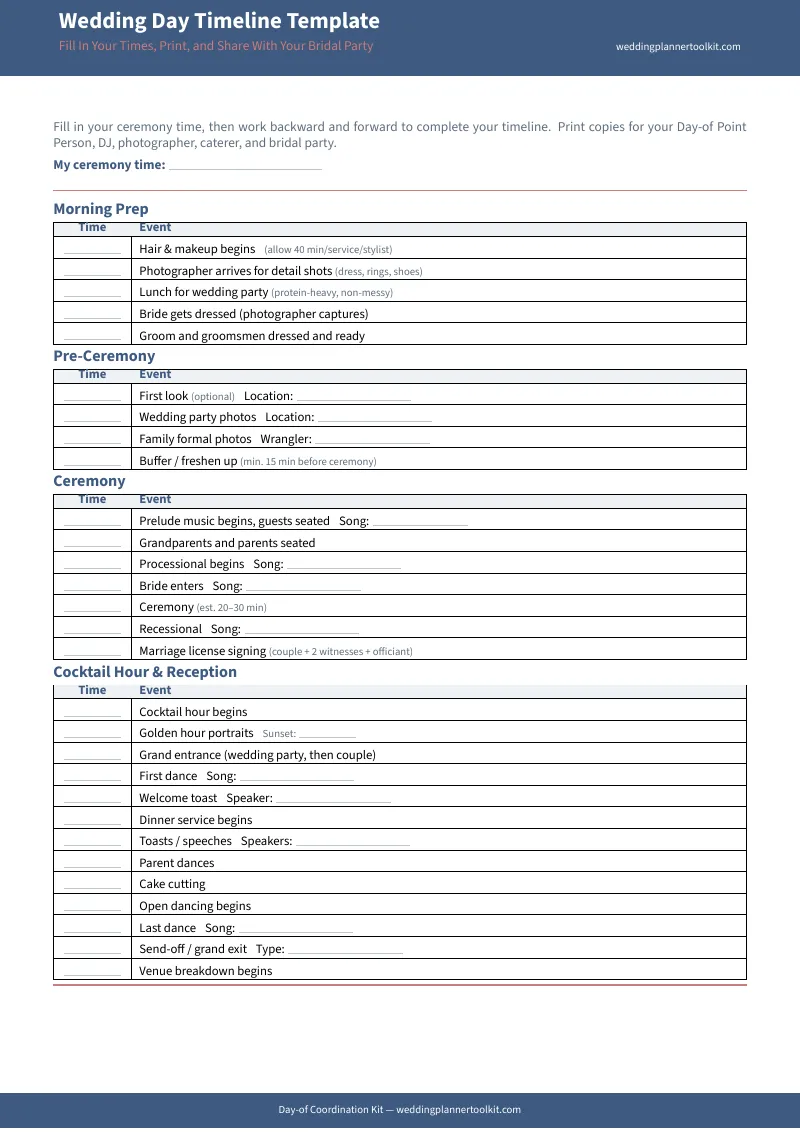
Not ready for the full kit? Download the free Wedding Day Timeline Template — a printable hour-by-hour schedule you can fill in tonight and share with your bridal party. It's the starting point. The full kit is the complete system.
You've spent months planning this wedding. Spend one evening making sure it actually runs the way you planned it.